
When it comes to battery performance, capacity is only part of the equation.
Internal resistance (IR) is a hidden factor that directly impacts efficiency, heat generation, and power delivery.
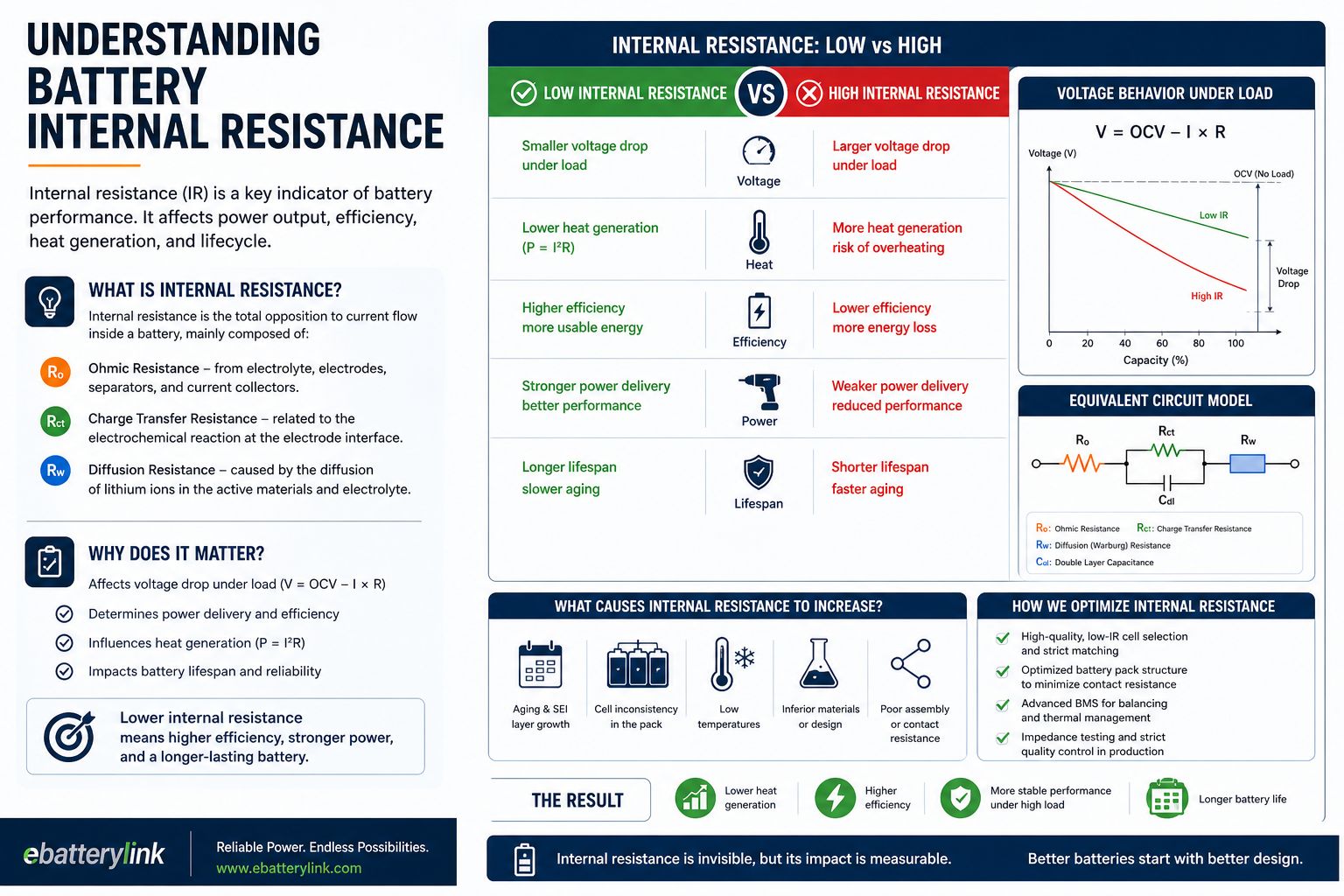
What is Internal Resistance?
It is the resistance to current flow inside the battery, including:
• Ohmic resistance (materials & connections)
• Charge transfer resistance (electrochemical reactions)
• Diffusion resistance (ion movement limitations)
Why It Matters:
Under load, battery voltage follows:
V = OCV − I × R
➡️ Higher IR = larger voltage drop
➡️ Less usable energy under load
➡️ More heat generation (P = I²R)
Low IR vs High IR:
✔️ Low IR → stable voltage, higher efficiency, longer lifespan
⚠️ High IR → power loss, overheating risk, faster aging
What Causes High IR?
• Cell aging (SEI growth)
• Poor cell matching
• Low temperature conditions
• Suboptimal materials or design
How We Optimize It at ebatterylink:
✔️ Low-IR cell selection & grading
✔️ Optimized pack structure
✔️ Smart BMS balancing & thermal control
✔️ Full-process impedance testing
The Result:
More stable performance, higher efficiency, and longer battery life — especially under high-load conditions.
👉 Internal resistance is invisible, but its impact is measurable.
Welcome to find more at:www.ebatterylink.com; eblpower@foxmail.com
话题标签BatteryTechnology 话题标签LithiumBattery 话题标签EnergyStorage 话题标签BMS 话题标签Engineering 话题标签PowerTools
Leave a Reply