When we talk about lithium battery performance, many people only focus on capacity.
But one critical, often overlooked factor directly determines efficiency, heat, power output, and service life: Internal Resistance (IR).
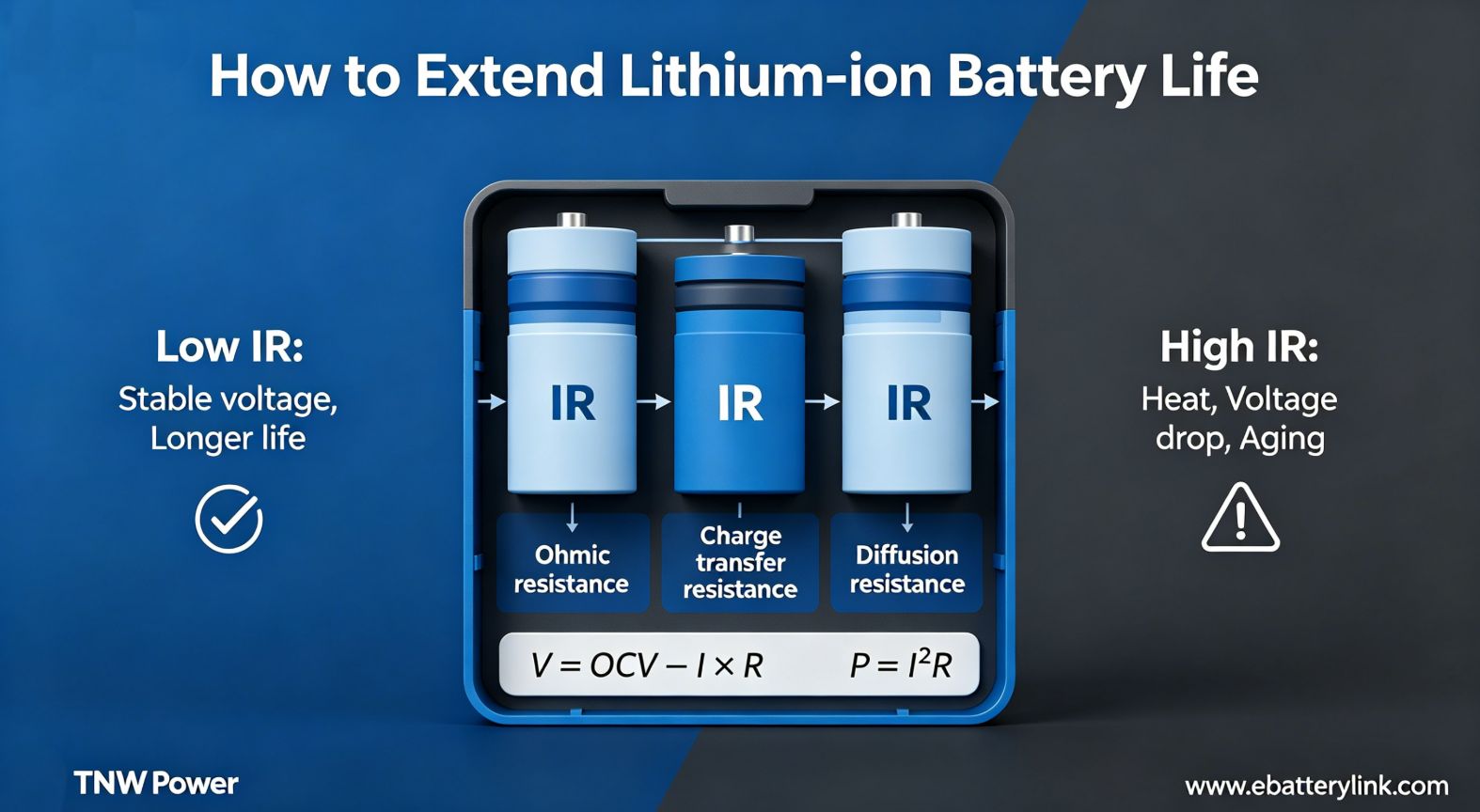
Internal resistance is the opposition to current flow inside the battery, consisting of:
Ohmic resistance (materials & connections)
Charge transfer resistance (electrochemical reaction speed)
Diffusion resistance (ion mobility limits)
Under load, battery voltage follows:
V = OCV − I × R
Higher IR = greater voltage drop
Less usable energy under heavy load
More heat generation (P = I²R)
Accelerated aging and shorter cycle life
Low internal resistance means:
✔ Stable voltage
✔ Higher energy efficiency
✔ Less heat buildup
✔ Longer service life
High internal resistance leads to:
⚠ Power loss and voltage sag
⚠ Overheating risk
⚠ Faster degradation
⚠ Poor performance in heavy-duty use
At TNW Power (ebatterylink.com), we control and minimize IR from the start:
✅ Low-IR cell selection and precision grading
✅ Optimized battery pack structure design
✅ Smart BMS with active balancing & thermal control
✅ Full-process impedance testing and quality control
For industrial applications like forklifts, low-IR design is not an option—it’s a necessity.
Stable power, higher efficiency, longer runtime, and longer overall battery life.
Internal resistance is invisible, but its impact is measurable.
Learn more: www.ebatterylink.com
TNWPower 话题标签LithiumIonBattery 话题标签BatteryTech 话题标签IndustrialBattery 话题标签ForkliftBattery 话题标签EnergyEfficiency
Leave a Reply